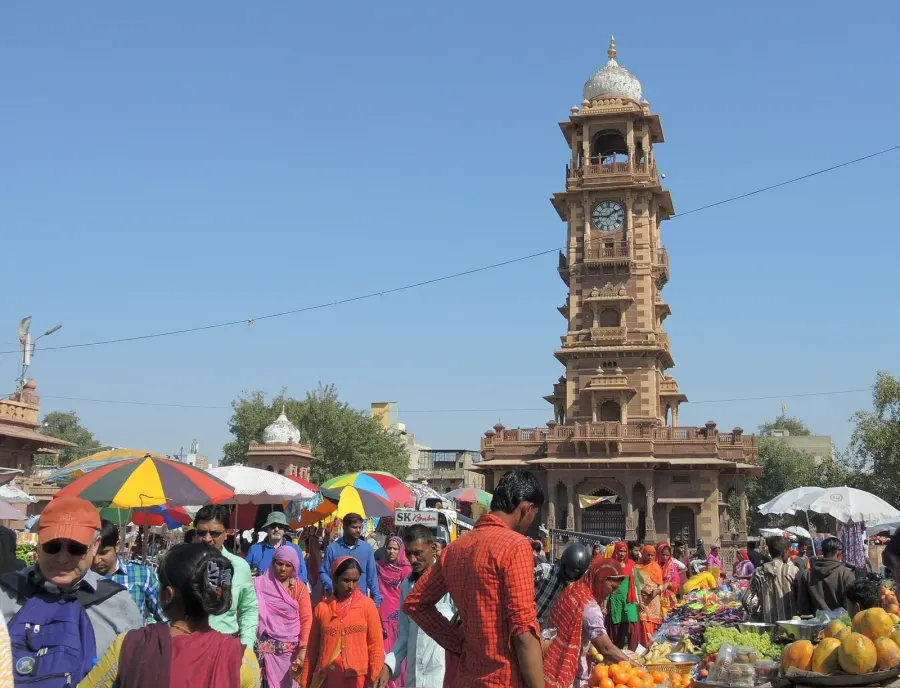
There is no official 2026 population to quote.
The last completed official Census is 2011. The Census A-04 workbook distinguishes three Jodhpur geographies rather than supplying one universal city number. The next population enumeration is scheduled for February 2027 with a reference date of 1 March 2027.
Rajasthan’s May–June 2026 activity was Phase I houselisting and housing work. It does not itself create a new official population count. Presenting a projection or commercial estimate as “the 2026 population” would erase that distinction.
Census year: 2011 · Geography: Jodhpur Urban Agglomeration · Official count: 1,138,300 · Current status checked: 9 August 2026.
An older district number may describe different land.
Rajasthan’s operational map in 2026 has 41 districts across seven divisions. Jodhpur is in Jodhpur Division; Phalodi is a separate district in that division. The 2011 Jodhpur district total of 3,687,165 belongs to the pre-separation district boundary and should not be silently attached to the present district.
This is why every demographic number needs both a year and a geography. Urban Agglomeration, Municipal Corporation, district, division, and the wider Jodhpur planning region are different units built for different purposes.
Jodhpur is the city and former capital. Marwar is the wider cultural region and historical polity. They are connected, not synonyms.
The postcard is blue. The city works.
Mehrangarh operates as a museum, conservation institution, and cultural venue. Its collections interpret painting, textiles, arms, furniture, and decorative arts across historic rooms and galleries. Beside the fort, Rao Jodha Desert Rock Park has worked since 2006 to restore roughly 70 hectares of degraded rocky land.
Rajasthan’s 2025–26 Panch Gaurav programme identifies wooden furniture as Jodhpur’s district product and Mehrangarh as its selected tourist destination. That is a current state-policy positioning, not proof that one craft represents the entire economy.
An older DC-MSME profile records furniture and handicraft alongside stone, stainless steel, guar, textiles and other industrial activity in its then Jodhpur district geography. EPCH’s 2024–25 report describes a Jodhpur Trade Facilitation Centre for development, promotion and marketing of the handicraft cluster. Together they establish real sector and institutional threads. They do not tell us how many enterprises or workers are active now, how value is divided, whether livelihoods improved, how informal work enters the chain, or what changed after district boundaries shifted.
Rajasthan Tourism reported 2,506,560 domestic and 203,945 foreign tourist visits to Jodhpur City for calendar year 2024. These are department-reported visits, not necessarily unique people.
Rajasthan Economic Review 2025–26 → (opens in a new tab)
EPCH annual report 2024–25 → (opens in a new tab)
A serious livelihood account needs dated sector data plus consented worker, maker and enterprise reporting across formal and informal work. Policy labels, export-promotion activity and tourist visits cannot substitute for wages, conditions, ownership, distribution or household experience.
Fort city, judicial seat, education and care.
Jodhpur remains the principal seat of the Rajasthan High Court. IIT Jodhpur, established in 2008, describes an 852-acre permanent campus. AIIMS Jodhpur, established in 2012, is part of the national tertiary-care and medical-education programme.
These institutions should not be narrated as direct descendants of princely authority. Their co-presence instead shows how the contemporary city exceeds any single heritage identity: court, campus, hospital, workshop, market, museum, and neighbourhood operate through distinct systems.
Rajasthan High Court
Jodhpur is its principal seat; Jaipur is designated as the bench.
IIT Jodhpur
Established 2008; the institute states an 852-acre permanent campus.
AIIMS Jodhpur
Established 2012 under the national tertiary-care and medical-education programme.
Mehrangarh Museum Trust
A functioning museum and conservation institution, not merely a monument operator.
A scheduled event is current—not completed.
Rajasthan Tourism lists the Marwar Festival for 24–25 October 2026 around regional music, dance, and narrative traditions. On this page, the dates remain labelled “scheduled” because 9 August precedes the event. Mehrangarh Museum Trust also presents the Rajasthan International Folk Festival and World Sacred Spirit Festival as recurring programmes.
The familiar “Blue City” identity is firmly present in current civic and tourism language. The archive uses that identity without claiming that every house is blue or selecting one unproven explanation—caste, cooling, insects, or otherwise—as the definitive origin of the colour.
Two specialist sources show why certainty would be premature. A 2019 heritage-survey record treats Jodhpur’s blue as a problem of historical surfaces requiring material, chromatic and conservation documentation. A 2026 participatory study reports, through focused expert interviews, an older Brahmapuri identifier, later spread beyond that area and a film-linked account of the public “Blue City” name. The publisher labels the accessible 2026 article an unedited version, and the reported interview account is not archival proof of a single citywide origin date.
The defensible conclusion is therefore narrower than “Jodhpur adopted blue paint in the late twentieth century.” Painted surfaces, wider adoption, tourist naming and later repainting are different chronologies. Resolving them requires dated images, material evidence, archives and consented neighbourhood oral histories rather than repetition of one attractive explanation.
2026 hyperlocal-resilience study → (opens in a new tab)
2019 historical-surfaces record → (opens in a new tab)
Neighbourhood, caste, gender, migration, labour and household history belong in the city record, but not as visual inference or tourist folklore. They require defined geography, consent, translation notes, privacy protection, census and archival context, and room for disagreement.
Current institutions and data do not prove what will exist in 2031. Continue with the official planning-horizon guide, where every estimate and named proposal keeps its status.