Jodhpur guide · planning
Count full Jodhpur days—not hotel nights or checklist stops
One day can reveal the essential city relationship, two days form the strongest first-visit baseline, and three days create room for landscape, an earlier capital, or a responsible regional layer.
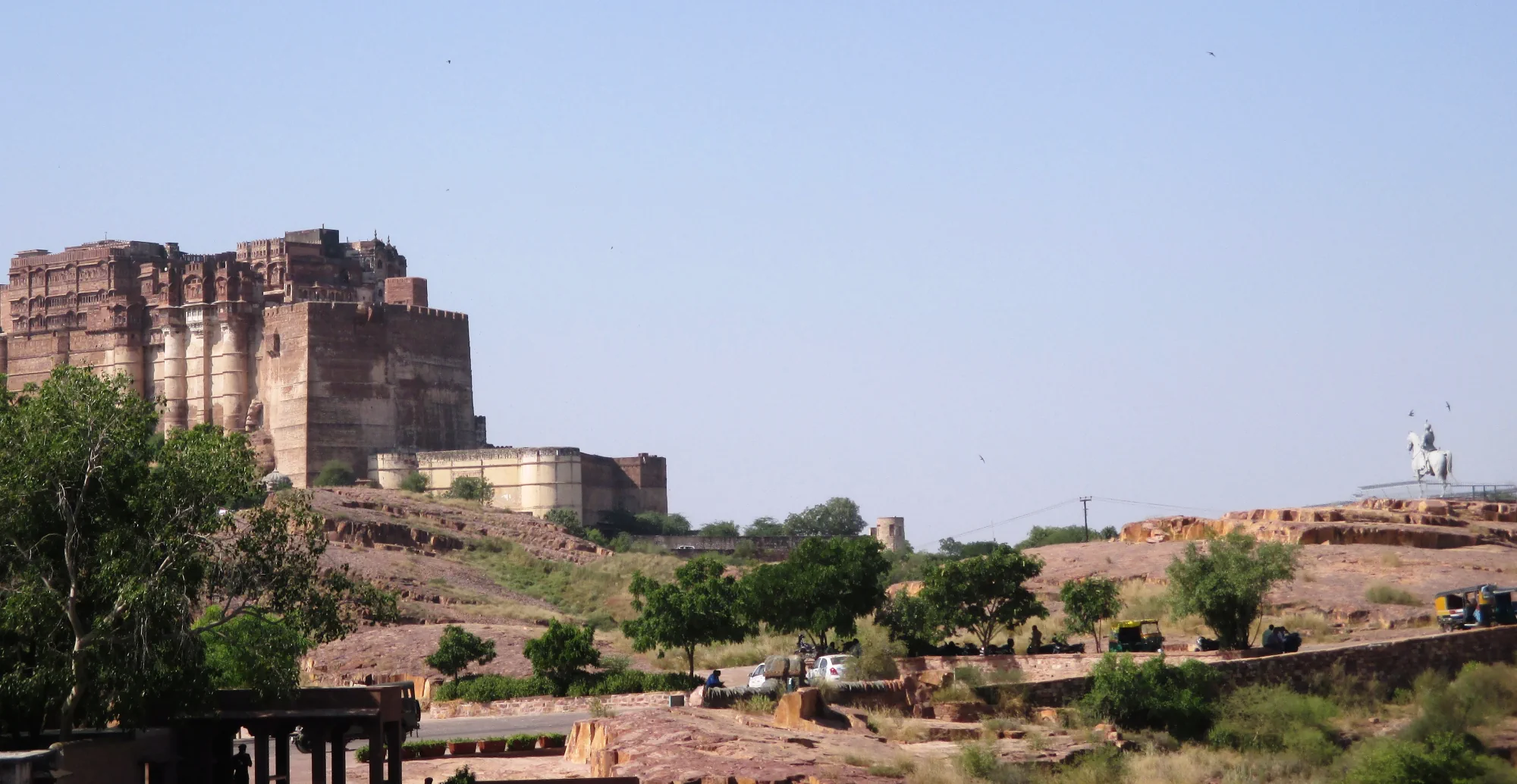
Photograph by Sreesarkar (opens in a new tab)· CC BY-SA 4.0 (opens in a new tab)
Check before you go
Hours, tickets, schedules, routes and access can change. Use the dated source links below, then confirm time-sensitive details with the responsible operator or venue before you travel.
Direct answer
Two full days are the most defensible baseline for a first Jodhpur visit. One day can work if the goal is to understand the fort, nearby memorial layer, and a measured part of the old city—not to collect every famous name. Three days are worthwhile when the third day creates depth: Mandore and earlier political geography, landscape restoration, craft and market context, slower city time, or a responsibly planned regional trip.
First calculate usable days
Do not count a late check-in as a sightseeing day. Start with the time between arrival at the accommodation and the moment the visitor must leave for the airport, station, or onward road. Remove transfer uncertainty, check-in, meals, sleep, luggage handling, and a realistic margin. What remains is usable time.
Use a simple calculation: total time in Jodhpur minus arrival, departure, transfers, meals, sleep, luggage and recovery. The result is planning capacity, not a booking or safety promise.
One day: the essential relationship
One day should answer a single question: how does the ridge, Mehrangarh, the memorial layer, and the living city below fit together?
The Museum Trust currently publishes 09:00–17:00 hours for Mehrangarh Museum and Jaswant Thada, with museum ticket sales closing at 17:00. That supports a morning-start structure but does not justify filling every minute. Allow for real museum interest, the route to Jaswant Thada, exposure, queues, a meal or rest block, and only as much old-city walking as remains humane.
Cut first: any distant second cluster. Do not add Mandore, Umaid Bhawan Palace Museum, a landscape walk, and a market circuit merely because they appear on a city-tour list.
Two days: the first-visit baseline
Day one can hold the high-relief city relationship: fort, nearby memorial, and old city. Day two should choose one additional lens rather than repeat day one with more transfers.
Possible lenses include:
- earlier capital and northern city geography through Mandore;
- twentieth-century palace/museum context with precise public-access limits;
- rocky-land restoration and ecology around Rao Jodha Desert Rock Park;
- craft, market, food, and neighbourhood systems with current local knowledge;
- water and land connections for a reader who wants depth more than a checklist.
Compare these by transfer burden, outdoor exposure, current access and the visitor profile they suit.
Three days: depth or region
The third day should change the scale of understanding. A slower city day may be more valuable than an excursion for a photographer, historian, older visitor, family, or anyone travelling in heat. A regional trip may suit someone with reliable transport, a specific interest, and enough time to understand the destination rather than stage a generic desert photograph.
Osian, Khejarli, Khimsar, and Nagaur are distinct destinations. Do not flatten temples, ecological memory, living communities, forts, and commercial “safari” products into one interchangeable day-trip category.
Pace changes the answer
| Visitor need | Planning adjustment |
|---|---|
| Deep museum interest | Protect more fort time; remove a late stop |
| Children or mixed-age group | Add food, toilet, shade, and unstructured buffers |
| Limited mobility | Verify drop-off, gradient, steps, lift status, surfaces, seating, and accessible toilets before route selection |
| Peak heat | Reduce exposed stops and move the outdoor block to the earliest viable opening window |
| Photography | Allow waiting and respectful positioning; never schedule homes or worship as a backdrop |
| Late arrival | Treat the arrival block as orientation, not a compressed “day one” |
What to confirm before you go
Use the duration logic and cut rules, then confirm transfer times, opening conditions, weather and any access support for the actual trip. The number of days can guide the plan; it cannot guarantee the pace, comfort or availability of every stop.
Sources behind this guide
Follow the sources—and know when to check again.
Official and institutional pages are linked with the date they were checked. They can establish a published fact, but not today's queue, route, access or conditions on the ground.
Source links
Official operator
Mehrangarh Museum visitor information (opens in a new tab)
Mehrangarh Museum Trust
Checked 13 Aug 2026· Current at last check
What this source does not tell you
- Hours, prices, concessions, closures, and access rules can change after the checked date
- The page does not prove queue time, visit duration, accessibility experience, or travel time
Official operator
Mehrangarh Museum Trust visit overview (opens in a new tab)
Mehrangarh Museum Trust
Checked 9 Aug 2026· Current at last check
What this source does not tell you
- The overview does not describe the route or a visitor's first-hand accessibility experience
- Every practical detail needs rechecking against the specific venue for the visit date
Government source
Jodhpur destination overview (opens in a new tab)
Department of Tourism, Government of Rajasthan
Checked 13 Aug 2026· Current at last check
What this source does not tell you
- Destination copy is not a substitute for venue-specific hours, prices, access, or current on-ground conditions
- Promotional wording does not independently establish current access or visitor conditions
- Its short reach section does not prove today's routes, operators, schedules, fares, terminal, road time, or last-mile availability
Government source
Climatological Information: Jodhpur station 42339, period 1991–2020 (opens in a new tab)
India Meteorological Department, Meteorological Centre Jaipur
Checked 9 Aug 2026· Historical dataset
What this source does not tell you
- The table is a 1991–2020 climate normal, not a forecast for a visitor's dates
- Station conditions do not describe every street, indoor space, or individual heat response
What this guide does not promise
- A promise that every named stop will be open or comfortable on the visitor's dates
- Live booking, transport, or attraction availability